
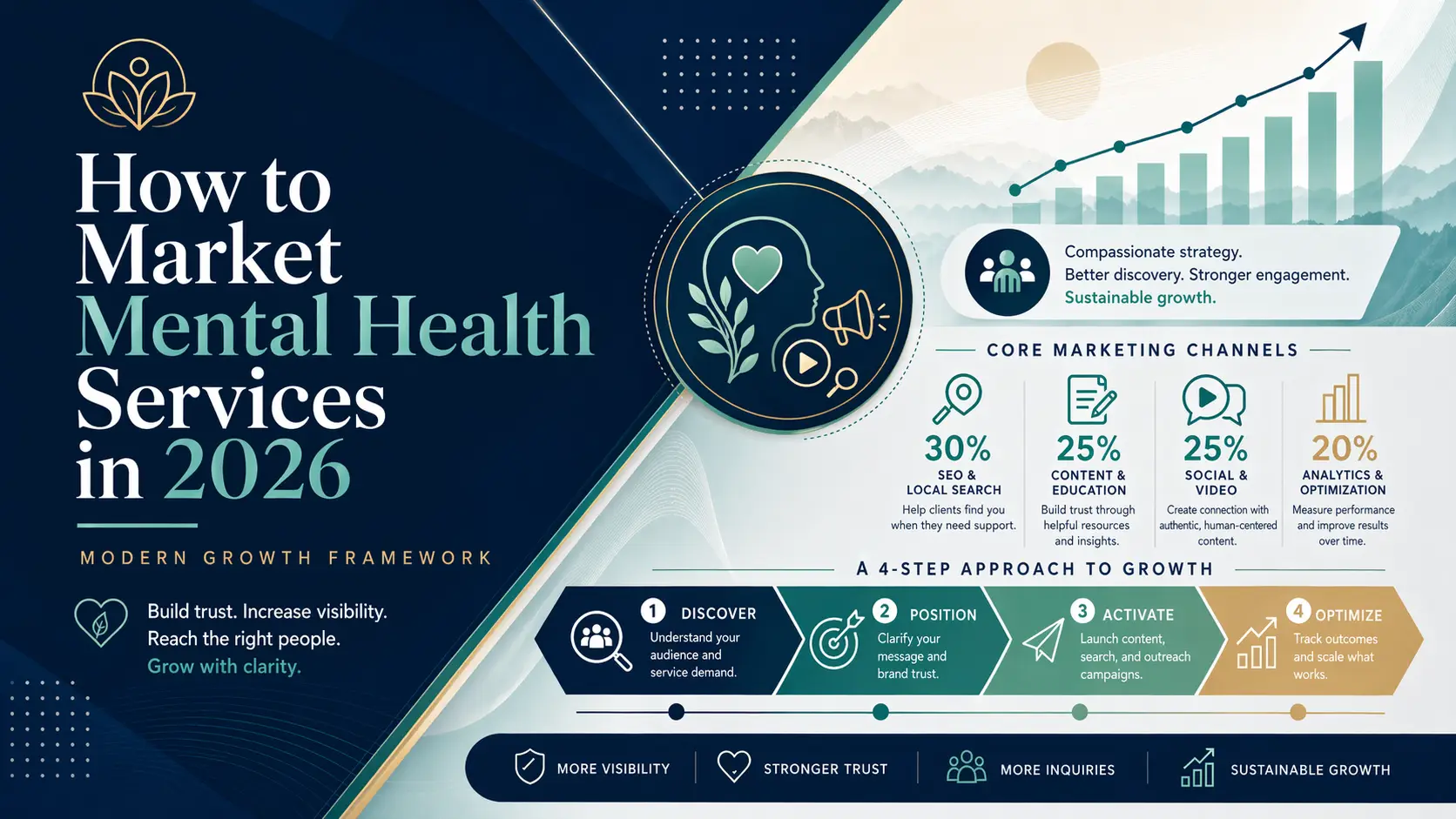
A practitioner-facing guide for solo therapists, group practices, and telehealth platforms building mental health caseloads in 2026 — with or without an agency. The seven steps that actually move the needle, the channels that don’t, and the metric that determines whether the whole program is working.
About this guide: Editorial guide maintained by Vital Youth Data Coalition. See methodology.
Who This Guide Is For
This guide is for the operator side of mental health practice marketing. Solo therapists building a private-pay or insurance-mixed caseload from zero. Group practices scaling from 3 to 15 clinicians. Telehealth platforms launching in new states. The framing assumes you want to understand the mechanics well enough to either run the marketing yourself in the early stage or evaluate agencies properly when you decide to outsource.
The mental health practice marketing landscape in 2026 is more crowded than it was three years ago. Psychology Today directory traffic per practice has compressed as more therapists join. Google Business Profile competition in major metros has intensified. Meta’s Special Ad Categories restrictions have tightened on health and wellness advertising. None of that is a reason to skip marketing — it’s a reason to do the foundation work that gets disproportionate ROI before adding paid layers on top.
The Seven-Step Sequence
Step 1: Define your ideal client profile
Before any channel decision, define the patient profile your practice converts on best. Modality fit (CBT, EMDR, ACT, psychodynamic, family systems), condition focus (anxiety disorders, OCD, complex trauma, ADHD, eating disorders), payer type (private-pay, in-network commercial, EAP, Medicaid), demographic concentration (LGBTQ-affirmative, BIPOC-focused, postpartum, late-career professionals), and geographic radius. The ICP definition is what makes every subsequent channel and creative decision tractable. Most therapists skip this step because it feels obvious; the ones who write it down explicitly outperform the ones who don’t.
Step 2: Set up Google Business Profile and basic local SEO
Claim your Google Business Profile and fully populate it: practice category (Psychotherapist or Counselor), service categories (specific modalities and conditions you treat), hours, phone, website, photos (clinical setting, not stock images), services with descriptions, and Q&A. Set up review collection — Google reviews are the single largest local ranking signal for therapy practices. Build basic local SEO on your website with location-and-condition pages (e.g., “anxiety therapist in [neighborhood]” with real, useful content).
Step 3: Build a HIPAA-compliant practice website
Mobile-fast, clean, no clutter. Required elements: clinician bio with credentials and theoretical orientation, modality and condition pages (one page per major service area), HIPAA-compliant intake form (NOT a generic contact form — use SimplePractice, TherapyNotes, or Hushmail forms), insurance and payment information, location and parking details. Avoid stock photos of distressed people; avoid generic mental health imagery. Real photos of you and your office build more trust than any other element.
Step 4: Get listed on the major therapy directories
Psychology Today is still the volume leader. Build a thorough profile with specific modality and condition language matching how prospective clients describe their issues. TherapyDen and Inclusive Therapists are credible alternatives with strong demographic-specific reach. Mental Health Match is growing. Goodtherapy and Therapy for Black Girls/Asian Mental Health Collective serve specific demographics well. Pick three directories minimum and maintain them quarterly.
Explore the Top 10 anxiety therapists in Naperville
Step 5: Build referral relationships with PCPs and adjacent specialists
For most local mental health practices, referral relationships from primary care physicians, OBGYNs, pediatricians, school counselors, and EAPs produce client volume at lower cost per acquisition than paid marketing. Identify the 20 highest-volume primary care offices in your service radius. Send a one-page introduction letter with your specialties, intake process, and direct contact. Follow up with a 15-minute in-person visit. Send periodic case-summary letters (HIPAA-compliant, no PHI) to referring providers to keep the relationship active. This is unsexy work that compounds.
Step 6: Run paid acquisition only after the foundation is solid
Google Ads and Meta paid social have a place — but only after Google Business Profile, website, directory listings, and referral relationships are working. Adding paid acquisition before the foundation is built means you’re paying to compensate for conversion gaps that would have been free to fix. When you do add paid, start with Google Ads on high-commercial-intent queries (anxiety therapist [city], EMDR therapist [city]) at modest budget ($500 to $1,500/mo) and measure cost per booked session. Meta paid social is the next layer; it operates inside Meta’s Special Ad Categories and requires more creative work for less precise targeting.
Step 7: Track inquiry-to-booked-session conversion, not just inquiry volume
The single most important metric is the percentage of inquiries that become first sessions. Below 25 percent is a conversion problem — your intake response time, screening process, fee discussion, or initial-call structure is leaking inquiries. Throwing more marketing at the top of the funnel will not fix a conversion problem; it will scale it. Above 50 percent inquiry-to-session conversion, you have permission to scale acquisition. Below it, fix the conversion gap first.
When to Hire an Agency
Not everyone needs a marketing agency. Solo therapists below 60 percent caseload utilization typically get faster ROI from owner-operated marketing because the marketing problem is execution, not strategy — and agency overhead at $1,500 to $3,500/mo is hard to justify when the operator has the time to do the foundation work themselves.
The point at which agency engagement becomes ROI-positive is when (a) caseload utilization has plateaued at 70 percent+ and the bottleneck has shifted from execution to strategy, (b) the practice has grown to 3+ clinicians and the marketing operations layer has become a real time investment, or (c) the practice has expanded to multiple locations or telehealth across multiple states. At that point a healthcare-vertical marketing agency that understands mental health practice economics usually outperforms continued owner-operated marketing.
Frequently Asked Questions
How do I market my mental health practice in 2026?
Foundation first: ICP definition, optimized Google Business Profile, HIPAA-compliant practice website, listings on Psychology Today and TherapyDen, systematic referral relationships with PCPs and adjacent specialists. Run paid acquisition only after the foundation is solid. Track inquiry-to-booked-session conversion as the headline metric.
How much should a solo therapist spend on marketing per month?
Below 60% caseload utilization, foundation channels are nearly free ($30 Psychology Today + $20 hosting + free GBP). Optional paid layer: $300 to $1,000/mo in Google Ads if practice has client capacity. Above 60% utilization, agency engagement at $1,500 to $3,500/mo often becomes ROI-positive.
What is the best marketing channel for therapists?
For most local solo and small group practices: PCP referral relationships first (lowest CAC), then Google Business Profile and local SEO, then directory listings (Psychology Today). Paid acquisition is right for telehealth platforms and group practices with intake capacity to scale.
Should I run Facebook or Instagram ads for therapy?
Maybe. Meta operates inside Special Ad Categories for health and wellness, which removes detailed targeting and demands creative quality. For solos with limited creative capacity, ROI is mixed. For groups and telehealth platforms with weekly creative production capability, Meta can produce booked sessions at competitive cost per session.
How do I get clients without paying for marketing?
Three free channels produce real volume: fully optimized Google Business Profile, systematic PCP referral relationships, and visibility in local professional networks. Combined unit economics often outperform paid acquisition for solos below 70% caseload utilization.
Authoritative sources
- SAMHSA Find Help resources — the public treatment locator our referral flows should align with.
- HHS HIPAA marketing guidance — the definitive rule set for mental health marketing communications.
Browse more operator guides on the behavioral health marketing blog.