
The math behind therapy and behavioral health practice marketing budgets — what $500/mo, $1,500/mo, $5,000/mo, and $10,000/mo actually buy, and how budget scales with revenue goals for solo therapists, group practices, and treatment centers.
About this article: Editorial guide from Vital Youth Data Coalition. See methodology.
The Math No One Wants to Do
The first honest question about therapy and behavioral health practice marketing is not “how much should I spend” — it is “what revenue outcome am I trying to produce?” Those two questions are the same question, but most practice owners answer them in the wrong order. They decide on a round-number budget ($500, $1,000, $1,500 per month), then hope the outcomes follow. The outcomes don’t follow because the math was never done.
Work it backward instead. If the revenue goal is $500,000 per year from a private-pay caseload at $180 per session, the practice needs roughly 2,800 billed sessions annually — which given typical case length and attrition requires somewhere between 400 and 700 new clients booked per year, or 35 to 60 new intakes booked per month. At a cost per booked session of $80 (a reasonable benchmark for mental health paid acquisition in 2026), that’s $2,800 to $4,800 per month in marketing spend — and that’s just the media layer, before the management fee or agency retainer.
The practice spending $500 to $1,000 per month and targeting that revenue outcome has a math problem. The practice spending $4,000 per month and tracking cost per booked session weekly has a system.
The Four Budget Tiers
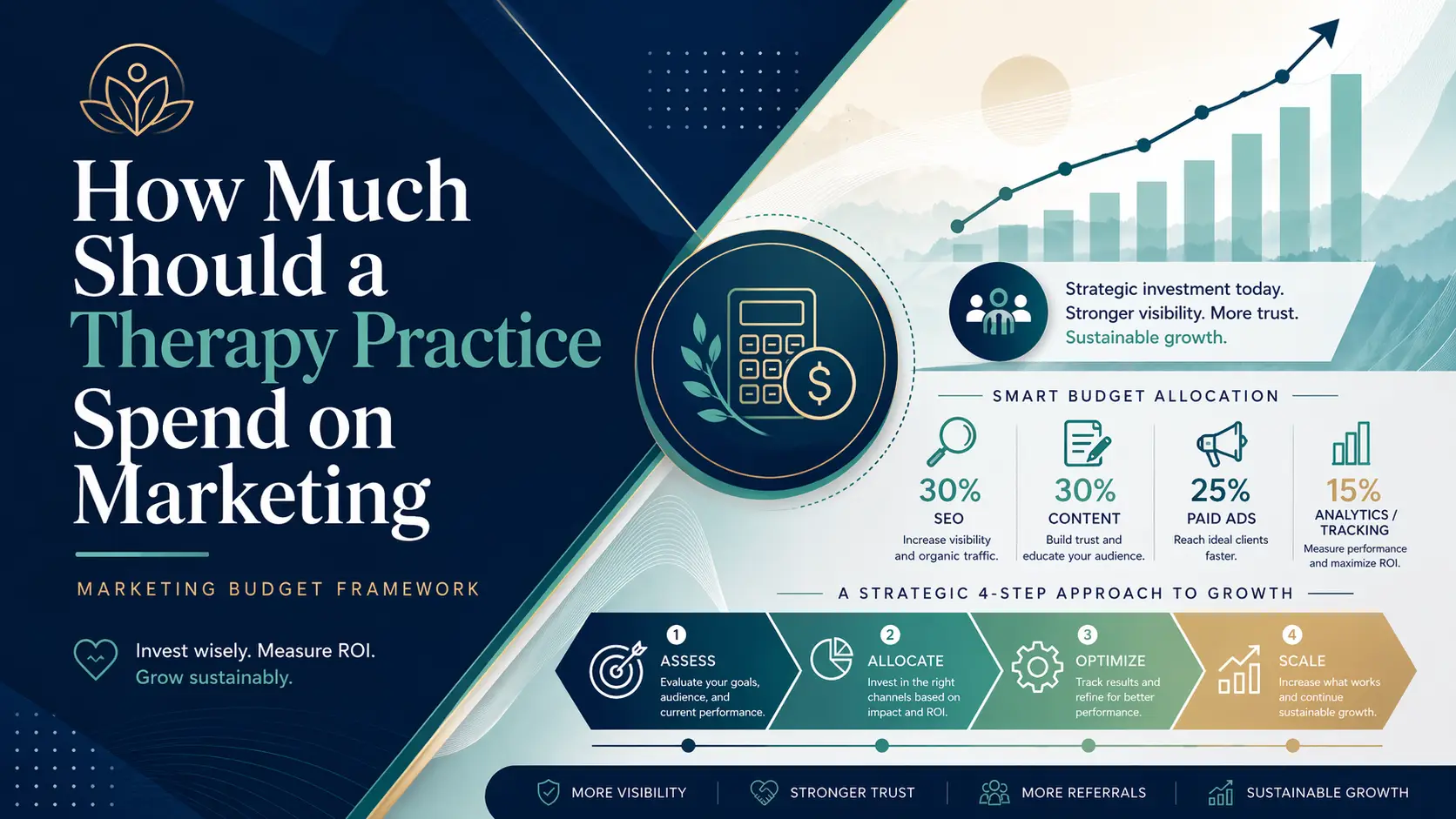
In practice, behavioral health marketing budgets sort into four tiers. The tier is determined by practice size and revenue goal, not by ambition alone.
| Tier | Combined Monthly Spend | Practice Profile | Realistic Outcome |
|---|---|---|---|
| Foundation | $300 – $1,000 | Solo therapist, caseload-building stage, <60% utilization | Psychology Today + GBP + referrals. Maintains visibility, builds slowly. |
| Growth | $1,500 – $3,500 | Solo at capacity, small group (2–4 clinicians) | Local SEO, Google Ads, modest Meta, content foundation. 15–35 new intakes/mo. |
| Scale | $3,500 – $7,500 | Group practice (5–15 clinicians), private-pay focus | Full-funnel marketing, aggressive content, paid acquisition scaled. 40–100 new intakes/mo. |
| Enterprise | $7,500 – $25,000+ | Multi-location, telehealth platforms, treatment centers | Multi-channel, multi-state. 100+ new intakes/mo; treatment centers tracking cost per admission. |
Behavioral health treatment centers (residential, PHP, IOP) typically operate at the upper end of the Enterprise tier because unit economics per admission support higher media intensity. Mental health practices with private-pay economics compound in the Growth and Scale tiers. ABA therapy providers usually land in the Scale tier because insurance-authorized case economics ($30,000 to $80,000 lifetime revenue per child) support meaningful paid acquisition investment.
What $1,000 per Month Actually Buys
A lot of solo therapists land at $1,000 per month combined because it feels like a “real” marketing budget. It is a real budget — but it buys incremental visibility, not transformative growth. Realistic line items at $1,000/mo:
- Psychology Today + TherapyDen + Inclusive Therapists profiles: ~$60
- Basic website hosting + domain: ~$25
- Google Business Profile optimization: free (your time)
- Light Google Ads media: $500 to $700
- Remaining ~$200 to $400 for content or a basic SEO retainer
This budget keeps a solo practice visible but does not fund growth into a group practice or multi-location model. Practices expecting scale outcomes at this budget tier are setting themselves up for 18 months of underperformance.
Investing Ahead of Growth (Not Behind It)
The practical math across healthy behavioral health marketing programs is that marketing investment should precede revenue growth by roughly one to two quarters. Building intake capacity and paying for acquisition ahead of the revenue means the lag between spend and outcome is absorbed in the ramp; waiting until revenue is already at the target before investing in marketing means you never get to the target because the acquisition engine never had time to compound.
For treatment centers specifically, the investment-ahead-of-growth pattern is even more pronounced. Admission economics per patient support meaningful media spend, but the learning phase on paid acquisition is 60 to 90 days — which means under-investing early produces worse cost per admission throughout the 18-month period that follows.
Solo vs. Agency: When the Math Shifts
Solo therapists below 60 percent caseload utilization usually get faster ROI from owner-operated marketing than from agency engagement at $1,500 to $3,500 per month. The foundation work — Psychology Today, Google Business Profile, basic local SEO, referral relationships — is within a clinician’s capability, and agency overhead is hard to justify when the operator has the time to do it.
The shift happens at the point where (a) caseload utilization has plateaued above 70 percent, (b) the practice has grown to 3+ clinicians and marketing operations has become a real time investment, or (c) the practice has expanded to multiple locations or telehealth across multiple states. At that point a healthcare-vertical marketing agency usually outperforms continued owner-operated marketing.
Frequently Asked Questions
How much should a therapy practice spend on marketing per month?
Four tiers: Foundation ($300–$1,000, solo caseload-building), Growth ($1,500–$3,500, solo at capacity or small group), Scale ($3,500–$7,500, 5–15 clinician group practices), Enterprise ($7,500–$25,000+, multi-location and treatment centers).
What does $1,000 per month in therapy marketing buy?
Psychology Today + directory profiles (~$60), hosting (~$25), light Google Ads ($500–$700), plus ~$200–$400 for content or basic SEO. Maintains visibility but does not fund scale.
What budget supports a million-dollar practice?
Approximately 80–150 qualified intake inquiries/mo at $60–$120 cost per booked session translates to $5,000–$12,000/mo combined investment. Seven-figure revenue on <$3,500/mo marketing consistently underperforms.
How much should a treatment center spend on marketing?
$7,500/mo (single location) to $25,000+/mo (multi-state networks) combined. Media at 1.5x–3x the management fee. Cost per booked admission benchmarks $200–$600 depending on specialty.
Agency or DIY marketing?
Solo therapists <60% utilization: DIY is faster ROI. Above 70% utilization, 3+ clinicians, or multi-location: agency engagement usually becomes ROI-positive because the bottleneck has shifted from execution to strategy.
Authoritative sources
- FTC Health Claims advertising guidance — for compliance considerations when setting a paid media budget.
- U.S. Small Business Administration: Marketing & sales — for general small-business marketing-budget benchmarks.
For more guides like this, browse the full VYDC blog.