
Most therapy practices that try to scale from solo to group to multi-location fail at the lead flow layer, not the clinical layer. The failures look the same every time — and they are avoidable.
The pattern that kills group practices: owner hires clinician → clinician caseload doesn’t fill in 90 days → owner cuts marketing to manage cash flow → lead flow gets worse → clinician churns within 6 months → practice loses the clinician, the caseload, and the reputation in the local clinician recruiting market. This is the single most common mechanical failure in therapy practice scaling.
The Scaling Mistake Most Practice Owners Make
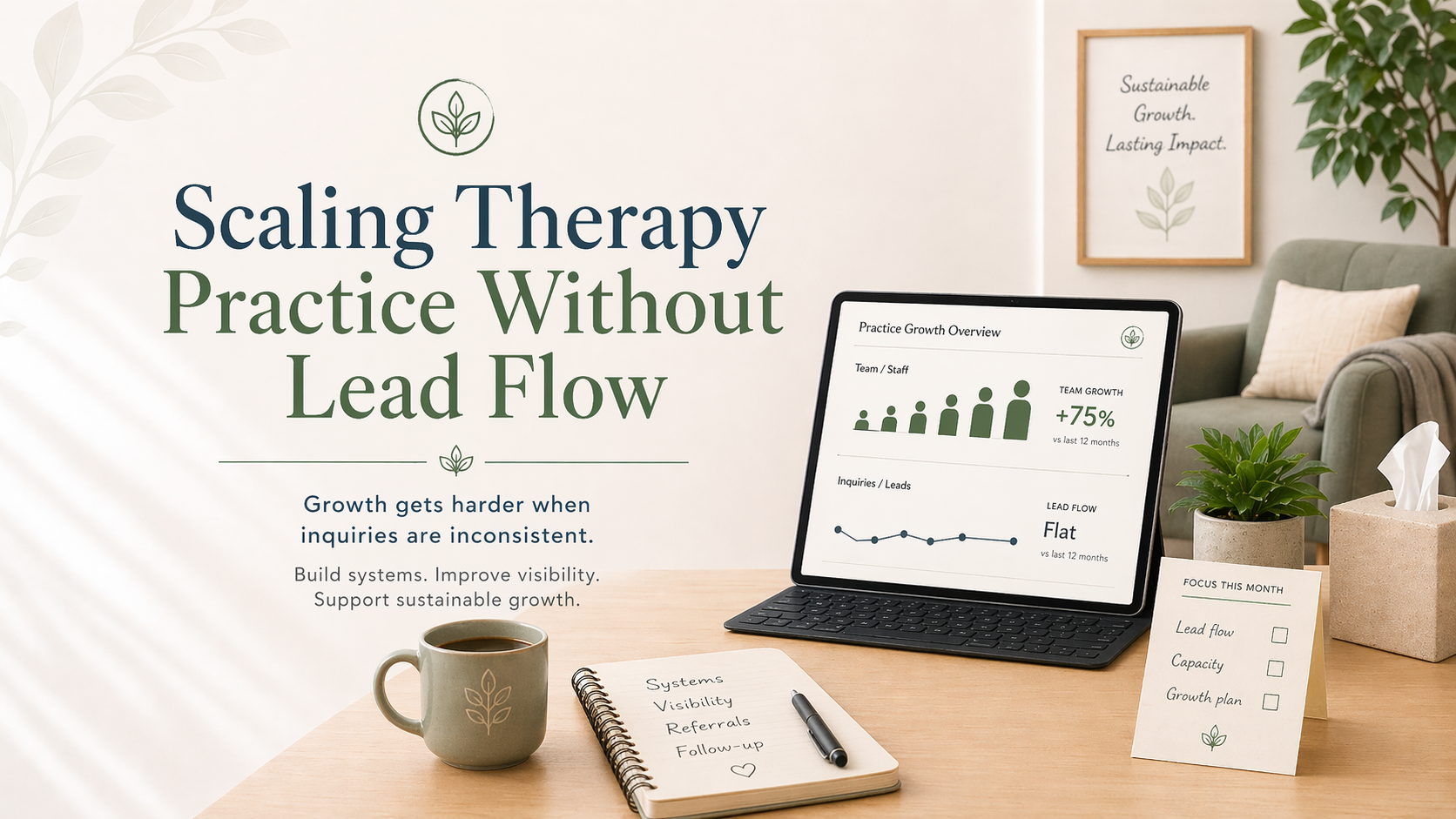
The scaling narrative most therapy practice owners absorb from consultants and peer groups is: hire more clinicians, fill more caseloads, grow revenue. The sequence sounds obvious. In practice, it destroys practices. The missing piece is the lead flow layer — the marketing system that actually generates enough patient inquiries to fill new clinician caseloads on the timeline the practice needs.
Most practice owners underestimate how much marketing infrastructure and investment is required to fill a new clinician’s panel. Solo therapist caseload fills slowly from referrals and organic acquisition because the owner has time, low overhead, and modest caseload targets. Scaling to 3 clinicians requires 3x the inquiry volume the solo practice was generating — which usually does not happen automatically. Marketing that worked for the solo stage stops working at the group stage, and the owner discovers this after the clinician is already hired and expecting a full panel.
The Cascade When Lead Flow Isn’t There
When clinical capacity exceeds lead flow, three things happen in sequence. First, the new clinician’s caseload doesn’t fill, which means the practice pays clinician salary (or fee-split draw) against empty panel hours — gross margin per clinician collapses. Second, the owner responds to the cash flow pressure by cutting marketing investment, which perpetuates the lead flow problem. Third, the clinician — watching the empty panel and sensing the practice doesn’t have the demand the hiring pitch promised — leaves within 6 to 12 months.
The owner ends up with: lost revenue from the empty panel during the clinician’s tenure, recruiting costs to replace them, reputation damage in the local clinician network, and a lead flow problem that is now worse than it was before the hire. The fix requires rebuilding marketing from a position of weakened cash flow — which is harder than building it from strength.
Explore the Top 10 anxiety therapists in Naperville
The Correct Sequence
Healthy scaling inverts the order: invest in marketing to generate demand before hiring clinicians to meet it. The sequence:
- Validate marketing capability at the owner-clinician level. Run the marketing plan (GBP, paid acquisition, content, referrals) for 60 to 90 days and document that inquiry volume and conversion produce a cost per booked session below gross margin per session. This is the baseline that scales.
- Generate demand beyond owner capacity. Continue investing in marketing until inquiry volume sustainably exceeds the owner’s panel capacity by at least 20 percent. This is the signal that a new hire can be supported.
- Hire the first clinician. The clinician’s panel should fill within 60 to 90 days because the demand was already there. If the panel doesn’t fill, the problem is operational (onboarding, assignment, panel construction), not demand.
- Scale hiring in proportion to marketing-generated demand. Each additional clinician should be hired only after inquiry volume justifies the capacity.
This sequence is boring. It is also the only one that consistently works. Practices that hop the sequence — hiring first, hoping marketing catches up — fail at predictable rates. Budget tier benchmarks for each stage are in our therapy practice marketing budget guide.
For Behavioral Health Centers Specifically
The stakes of this mistake are higher for behavioral health centers than for mental health group practices. Treatment centers operate with higher fixed costs (beds, facility, 24/7 staffing), which means empty capacity is meaningfully more expensive. A residential program with empty beds is losing $400 to $800 per bed per day in unrecovered overhead; the cash flow pressure from capacity expansion without corresponding demand generation can crater a facility in a single quarter.
The correct sequence for treatment centers is the same but more rigorous: validate paid acquisition produces admissions at target cost per admission for 90 days before adding bed capacity, then scale capacity only when admission volume sustainably exceeds existing bed utilization.
Frequently Asked Questions
Why is scaling without lead flow dangerous?
Unfilled new-clinician caseloads compress margin, damage retention, and force marketing cuts that perpetuate the problem. Pattern repeats predictably.
How should therapy practices sequence hiring and marketing?
Marketing 1–2 quarters ahead of hiring. Validate inquiry volume exceeds owner capacity by 20%+, then hire.
What happens to clinicians hired into empty caseloads?
Typically leave within 6–12 months. Recruiting cost plus lost revenue compounds the initial scaling mistake.
For more guides like this, browse the full VYDC blog.