
YMYL standards, E-E-A-T for clinical content, video formats that convert, and distribution strategy across organic search and social — for behavioral health, mental health, and ABA practices building authority and acquisition through content in 2026.
About this guide: Maintained by Vital Youth Data Coalition. See methodology.
Why Behavioral Health Content Is a Different Discipline
Content marketing for behavioral health operates inside a tighter quality threshold than content for most other industries. Google classifies mental health, addiction recovery, and clinical behavioral content as YMYL — Your Money or Your Life — meaning content that affects health, safety, or wellbeing decisions. YMYL content is held to higher E-E-A-T (Experience, Expertise, Authoritativeness, Trustworthiness) standards in ranking, which means generic content written by marketing copywriters underperforms clinical content written or reviewed by credentialed practitioners.
The practical implication for behavioral health operators: content marketing only produces ranking and acquisition value when it’s built to the higher quality threshold. Volume content strategies that work for e-commerce or B2B SaaS underperform in mental health and addiction-related search. The behavioral health practices that win in organic content treat each piece as a small clinical authority asset, not as a checkbox in an editorial calendar.
YMYL and E-E-A-T in Practice
The YMYL framework translates into specific content production standards for behavioral health:
- Author credentials visible: Every published article needs a credentialed clinical author or reviewer (BCBA for ABA content, LCSW/LPC/PhD for mental health content, MD or DO for medication-related content). Author byline with credentials, photo, and brief bio appears on every page. Generic “by the editorial team” bylines underperform.
- Peer-reviewed citations: Where possible, content cites peer-reviewed clinical literature, government health resources (NIMH, SAMHSA, CDC), or established clinical authorities. Citations build E-E-A-T weighting and protect against misinformation flagging.
- Specific over generic: Specific clinical content (specific OCD subtypes, specific trauma presentations, specific ADHD comorbidities) ranks better than generic content (5 tips for anxiety, what is depression). Search intent in behavioral health is increasingly specific in 2026.
- Last-reviewed date prominent: Behavioral health information shifts as research evolves. Content with prominent last-reviewed dates and active update cadences signals trustworthiness.
- Editorial separation from sales: Educational content should serve patient understanding, not pitch the practice. Soft CTAs at the end of educational content convert better than sales-led content with thin clinical value.
Video Formats That Convert
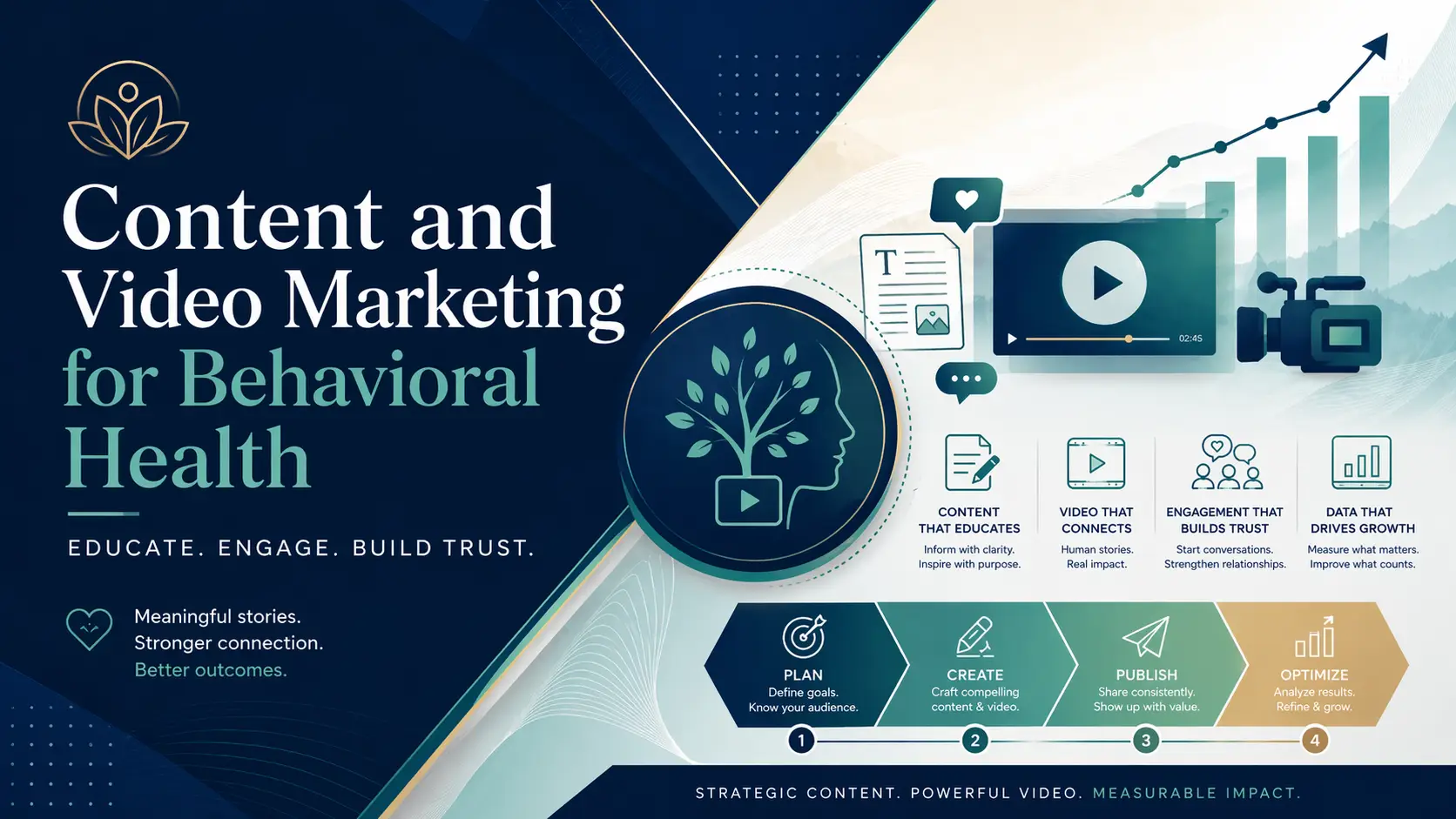
Video for behavioral health practices works in three formats consistently. Practices that produce these three formats systematically outperform practices that chase platform-specific content trends.
1. Clinician Introduction Videos (90–180 seconds)
The single highest-converting video asset for any therapy or behavioral health practice is a warm, professional clinician introduction. Shows: who you are, what you treat, theoretical orientation in plain language, what the first session is like, who you work best with. Lives on the practice website’s home page and clinician bios; cuts down for Instagram and TikTok. Most therapy clients watch this video before booking; not having one creates measurable conversion drag.
2. Condition Explainer Videos (3–8 minutes)
Long-form clinical content explaining specific conditions (what panic disorder feels like, what postpartum OCD looks like, what high-functioning autism presents as). These are evergreen authority assets — they rank in Google search, embed on the practice’s condition pages, and build YouTube channel authority over time. Best fit for treatment centers, group practices, and ABA networks with capacity to produce monthly long-form video.
3. What-to-Expect Videos (60–120 seconds)
Friction-reduction content addressing the practical questions patients have before booking: what happens in the first session, how insurance works, what telehealth therapy is like, what to expect from EMDR or ABA or specific treatment modalities. Lives on landing pages and intake confirmation flows. Reduces inquiry-to-session conversion drag by addressing concerns that would otherwise become no-shows.
Distribution Strategy
Production without distribution is wasted effort. Each piece of content should be produced once and distributed across multiple surfaces with format adaptation: long-form article on the practice website (organic search), 60 to 90 second clip on Instagram and TikTok (social discovery), full video on YouTube (long-form authority), and a snippet in the practice’s email newsletter (existing-patient retention and referral activation). The repurposing cadence is what makes content marketing economically viable for behavioral health practices that don’t have dedicated content teams.
For ABA practices specifically, parent-facing content has higher repurposing potential than adult mental health content because the audience consumes information across more channels (Facebook groups for autism parents, YouTube long-form, podcast adjacent content).
Frequently Asked Questions
What are YMYL standards for behavioral health content?
YMYL = Your Money or Your Life. Behavioral health content is YMYL — Google requires high E-E-A-T signals to rank. Practical implications: visible clinical credentials, peer-reviewed citations, content reviewed by credentialed clinicians.
What video formats convert best for behavioral health?
Three formats: clinician introduction videos (90–180s), condition explainer videos (3–8 min, evergreen), what-to-expect-in-first-session videos (60–120s). Patient story content can convert powerfully with HIPAA-compliant production.
Should behavioral health practices write blog content?
Yes, when written to YMYL standards: condition-specific (not generic), credentialed clinical authors, peer-reviewed citations, specific search intent addressed. Generic mental health content underperforms in 2026 SERPs.
How often should a behavioral health practice publish content?
Quality matters more than frequency. Solo practices: 2 to 4 long-form pieces monthly. Group practices and treatment centers: 4 to 8 monthly plus 2 to 4 video pieces. The threshold for ranking-and-converting content is higher than most practices anticipate.
Authoritative sources
- Google Search Central: Video best practices — for technical video SEO requirements.
- NIMH Mental Health Statistics — a primary source we recommend citing in clinician-led content.
For more guides like this, browse the full VYDC blog.